Quick Listen:
Hybrid corporate meetings have moved well beyond being a temporary response to distributed work. For many organizations, they are now a structural part of how leadership communicates, how teams align, and how training is delivered across dispersed workforces. The challenge is no longer whether hybrid formats should exist, but how to design and produce them so that in-person and remote participants share the same clarity, engagement, and value from the experience.
For teams responsible for modern corporate meetings, this shift places new pressure on production quality, communication strategy, and technology integration. Hybrid meeting environments require more than simple video conferencing they demand intentional design choices that support attention, interaction, and measurable outcomes across both physical and digital spaces.
When your most important meeting, launch, summit, or training experience needs to move people, every detail matters. Strategy guides the work. Creativity shapes the story. Precision brings it to life. DEVLINHAIR Production & Learning designs and produces action-driven meetings, live events, and training experiences that move audiences. From our New York City studio, DEVLINHAIR helps organizations bring complex ideas, leadership priorities, and learning moments to life with clarity, purpose, and production precision. Ready to create a hybrid experience your audience can follow, feel, and act on? Let’s talk.
From Hybrid Adoption to Hybrid Expectations in Modern Corporate Meetings
The evolution of hybrid corporate meetings has accelerated as organizations recognize that flexibility alone is not enough. What once began as an access solution for remote participation has become a baseline expectation for engagement quality, data visibility, and content longevity.
Industry analysis shows that hybrid formats are increasingly viewed as a core part of B-to-b event strategy, not a secondary layer added to in-person programs. According to 2025 state of the B-to-b events industry data and benchmarks, organizations are placing greater strategic importance on event experiences while simultaneously demanding stronger proof of impact and return. This combination is reshaping how hybrid meeting capabilities are designed and evaluated.
Instead of treating hybrid as a delivery option, corporate teams are now expected to design meetings where both audiences on-site and remote receive equivalent narrative structure, engagement opportunities, and access to key decision moments. That expectation has fundamentally changed the production brief for corporate meeting planners, learning teams, and communications leaders.
At its best, hybrid design merges the energy of live gatherings with the reach and flexibility of digital participation. It enables corporate training programs to scale effectively while giving product demonstrations the interactivity and storytelling depth they deserve. This approach focuses not on technology for its own sake, but on creating experiences that foster alignment, deeper understanding, and lasting action.
Why Hybrid Capabilities Are Central to Engagement and ROI
Hybrid meeting capabilities are increasingly tied to how organizations measure engagement and justify investment in large-scale meetings. When designed intentionally, hybrid formats create more structured pathways for participation, allowing organizations to extend content reach while maintaining control over messaging consistency.
Rather than viewing hybrid as a cost-driven compromise, many organizations are now using it as a strategic extension of audience engagement. The same research highlights that hybrid infrastructure can expand audience access while also supporting more structured data capture across attendance, participation, and engagement signals.
This is where hybrid corporate meetings begin to deliver value beyond logistics. When remote participation is designed with intention rather than treated as passive viewing it becomes part of a broader engagement ecosystem that connects meetings to downstream business outcomes.
Importantly, hybrid formats also help organizations stretch the lifecycle of a single meeting. Content can be repurposed, revisited, and reactivated across teams that could not attend live, creating more sustained value from a single investment in production and planning.
Measurement Shifts Shaping Hybrid Meeting Strategy
One of the most significant drivers behind the adoption of hybrid meeting capabilities is the growing demand for measurable outcomes. Leadership teams increasingly expect corporate meetings to demonstrate clear connections between participation and business performance.
Insights from senior event leaders highlight a shift toward engineered accountability, where measurement frameworks are designed before the meeting begins rather than evaluated afterward. As documented in measuring pipeline impact and ROI from corporate B-to-b events, organizations are moving toward more integrated tracking models that connect event engagement with broader business systems.
This approach is especially relevant in hybrid environments. Virtual participation provides structured data signals that can be compared directly with in-person engagement, allowing teams to evaluate how different audience segments interact with content, sessions, and messaging.
For corporate meeting planners and production teams, this creates a new expectation: hybrid meetings must be designed not only for experience quality, but also for data clarity. The ability to understand who engaged, how they engaged, and what actions followed the meeting is becoming essential for securing continued investment in corporate events.
Designing Hybrid Experiences That Serve Two Audiences at Once
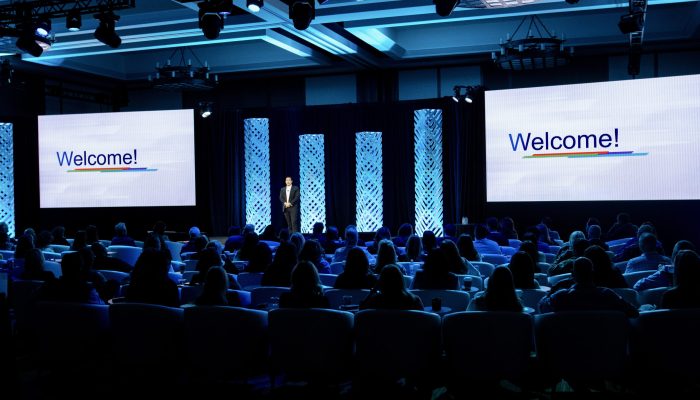
Designing effective hybrid corporate meetings requires balancing two distinct audience experiences without fragmenting the message. In-person attendees experience the physical energy of the room, while remote participants rely on production clarity, camera framing, and structured digital interaction points.
The most effective hybrid meeting strategies treat these as parallel but interconnected experiences. This means designing agendas that account for attention spans in digital environments, integrating structured moments for interaction, and ensuring that remote participants are not reduced to passive observers.
Successful hybrid meeting design also depends on narrative alignment. Both audiences must receive the same strategic message, but the way that message is delivered may differ based on format. This requires coordination between content strategy, production direction, and technology integration teams to ensure consistency across all touchpoints.
When done well, hybrid formats enhance inclusivity without diluting impact. They allow organizations to scale participation while maintaining the integrity of leadership messaging and learning outcomes.
Technology Integration and Production Alignment in Hybrid Meeting Capabilities
Technology plays a central role in enabling hybrid meeting capabilities, but it is only effective when aligned with production strategy. Meeting platforms, streaming systems, and engagement tools must work together seamlessly to support a unified experience.
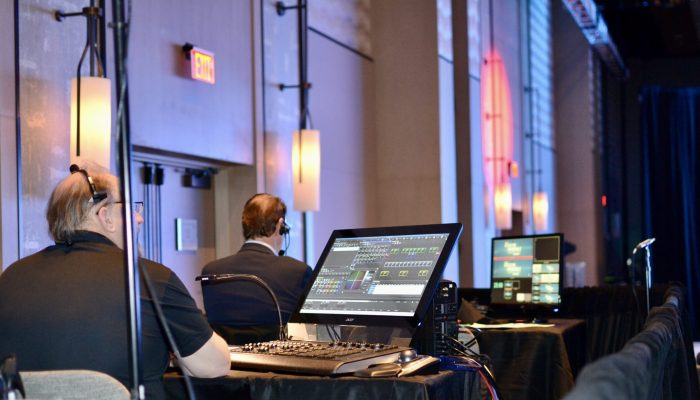
However, technology alone does not solve engagement challenges. The real value emerges when production design and technical infrastructure are developed together from the start. This includes camera strategy, audio clarity, stage design, lighting, and digital interface planning for remote audiences.
Hybrid corporate meetings also require careful coordination between live production teams and virtual experience teams. Without this alignment, remote participants often experience delays in interaction, inconsistent audio-visual quality, or limited engagement opportunities.
As hybrid formats become more sophisticated, organizations are prioritizing integrated systems that support real-time interaction and consistent delivery across both environments. This shift reinforces the need for production partners who understand both live event execution and digital experience design.
What Leaders Should Prioritize in Hybrid Corporate Meeting Strategy
For organizations planning modern corporate meetings, hybrid success depends less on platform selection and more on intentional experience design. Leaders must consider how information flows across audiences, how engagement is structured, and how outcomes are measured.
Hybrid meeting capabilities should be viewed as an extension of organizational communication strategy rather than a standalone technical feature. When aligned correctly, they support clearer messaging, broader participation, and stronger post-event insights.
Production partners such as DEVLINHAIR Production & Learning approach this through a combination of strategy, creativity, and execution discipline. Strategy guides the work. Creativity shapes the story. Precision brings it to life. We design and produce action-driven meetings, live events, and training experiences that move audiences.
As hybrid corporate meetings continue to evolve, the organizations that succeed will be those that treat hybrid not as an add-on, but as a fully integrated capability embedded into how meetings are planned, produced, and measured.
Hybrid Capabilities as a Defining Feature of Modern Meetings
Hybrid corporate meetings are no longer defined by their format but by their effectiveness. The organizations that gain the most value are those that design for engagement, measurement, and consistency across both in-person and remote participants.
As expectations continue to rise, hybrid meeting capabilities will remain central to how corporate meetings are designed, delivered, and evaluated. For leaders responsible for communication, learning, and engagement, the focus is shifting toward building experiences that are not only accessible, but also strategically measurable and operationally aligned.
Frequently Asked Questions
What are hybrid capabilities in modern corporate meetings?
Hybrid capabilities in modern corporate meetings refer to the integrated design and production of events that serve both in-person and remote audiences at the same time. They combine live event production, streaming technology, and structured engagement strategies to ensure both audiences receive the same core message and experience. In corporate meetings, this includes aligning content, interaction, and measurement so participation is consistent across formats. Production partners like DEVLINHAIR Production & Learning use these capabilities to create unified, action-driven meeting experiences.
How do hybrid corporate meetings improve engagement and ROI?
Hybrid corporate meetings improve engagement and ROI by expanding audience reach while enabling more structured participation and data capture. They allow organizations to extend the lifecycle of meeting content through repurposing and ongoing internal distribution. This helps connect engagement signals to measurable business outcomes such as learning impact or communication effectiveness. When designed intentionally, hybrid formats turn corporate meetings and training experiences into scalable engagement systems.
What should organizations prioritize when planning hybrid corporate meetings?
Organizations should prioritize experience design, production alignment, and clear measurement frameworks when planning hybrid corporate meetings. This ensures that in-person and remote audiences receive consistent messaging and equally engaging experiences. Strong coordination between technology, content strategy, and live production is essential for seamless delivery. DEVLINHAIR Production & Learning emphasizes designing hybrid meetings that are not only technically sound but also strategically aligned with communication and learning goals.
Disclaimer: The above helpful resources content contains general insights and perspectives for informational purposes only. The information provided is for general knowledge and does not constitute professional advice.
You may also be interested in: Brands Seek Expertise in Producing High-impact Leadership Events
When your most important meeting, launch, summit, or training experience needs to move people, every detail matters. Strategy guides the work. Creativity shapes the story. Precision brings it to life. DEVLINHAIR Production & Learning designs and produces action-driven meetings, live events, and training experiences that move audiences. From our New York City studio, DEVLINHAIR helps organizations bring complex ideas, leadership priorities, and learning moments to life with clarity, purpose, and production precision. Ready to create a hybrid experience your audience can follow, feel, and act on? Let’s talk.
Powered by flareAI.co